
India, in Beta: The World’s Messiest Management Classroom
A market tour treats India like a museum: a guided walk past big numbers, big brands, and bigger traffic. An executive-learning visit should treat it like a laboratory: hypotheses, constraints, live experiments and a few failed trials that teach more than the successful ones.
India is not “emerging” so much as iterating. It ships new operating models in the open and at a scale that makes even competent management look like a contact sport. The most useful takeaway for a senior cohort is not a list of sectors to admire, but a set of muscles to build: decision-making under ambiguity, orchestration across frictions, and reinvention when the original plan meets the real country.
Scale is the easy part. Speed is the lesson.
Start with the macro, only to move past it. The IMF’s India profile and forecasts still place the country among the faster-growing large economies (the exact numbers shift with every update, but the broad point remains: growth is strong enough to make transformation feel urgent). (https://www.imf.org/external/datamapper/profile/IND)
But “growth” is the least interesting statistic for managers. The more instructive number is throughput. How fast India forces organisations to process complexity.
Take payments. India’s UPI is not merely popular; it is industrial-scale behaviour change. In December 2025, UPI processed 21.63 billion transactions worth ₹27.97 lakh crore (~$305.1bn), averaging ~698 million transactions a day. (Entrackr) That is not a fintech story; it is a management story about trust, interface design, incentives, grievance redressal, fraud controls, and partnership governance, running at a national cadence.
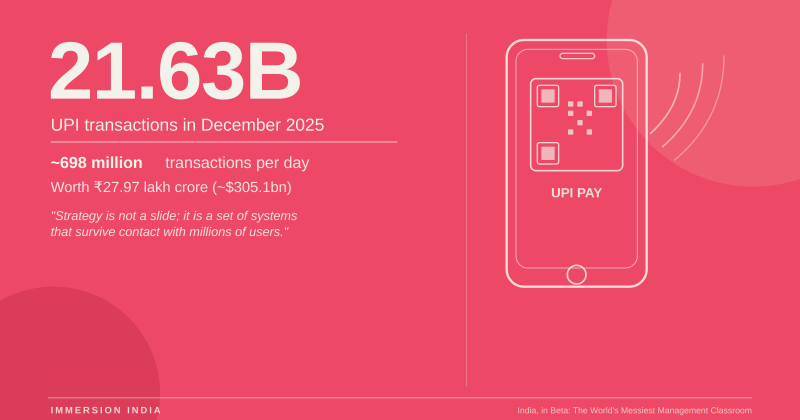
A cohort watching this up close learns something uncomfortable: strategy is not a slide; it is a set of systems that survive contact with millions of users who will not read your FAQ.
Constraint is not a bug. It’s the curriculum.
In many economies, constraints are episodic, indeed supply-chain shocks, a policy change, a bad quarter. In India, constraint is ambient: infrastructure gaps beside world-class digital rails; talent scarcity in one pocket and abundance in another; formal and informal markets braided together.
This is why India behaves like a management gym. Consider three “constraints as teachers” that cut across sectors:
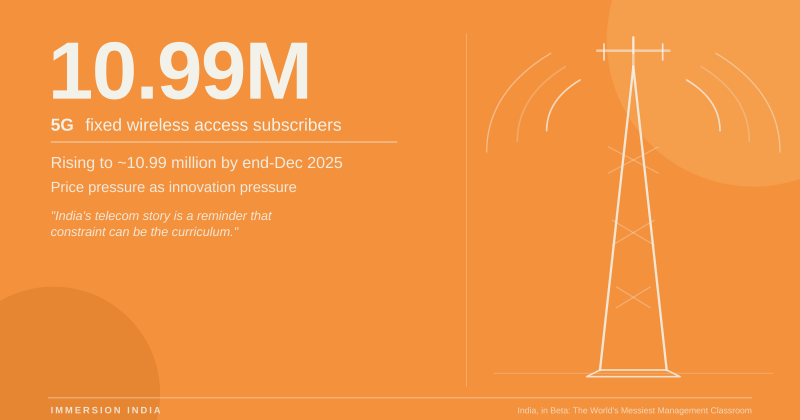
Bandwidth at low cost, at high usage. India’s telecom story is a reminder that price pressure can be innovation pressure. Government releases point to extremely low data costs (and a massive telecom footprint), while TRAI reporting shows the continuing expansion of advanced connectivity, including 5G fixed wireless access subscribers rising to ~10.99 million by end-Dec 2025. (Press Information Bureau)
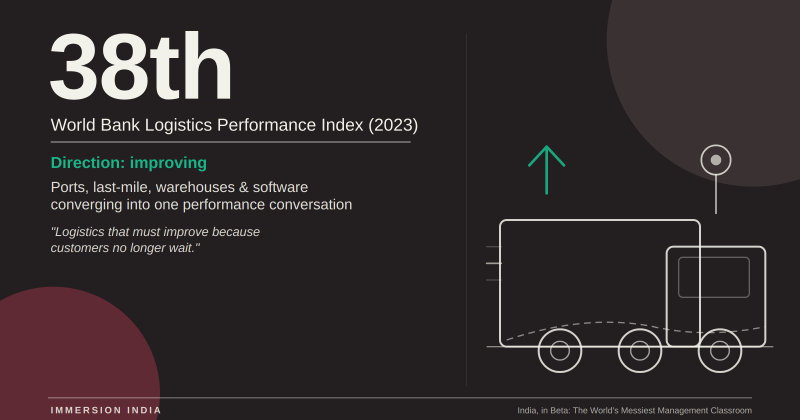
Logistics that must improve because customers no longer wait. World Bank LPI data places India at 38th overall (2023), with a sharper standing on “international shipments.” (lpi.worldbank.org) The point is not the rank; it is the direction: ports, warehouses, last-mile partners and software are being pulled into a single performance conversation.
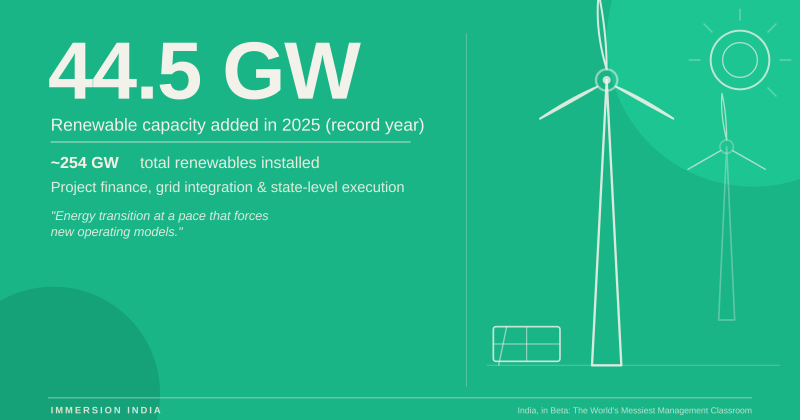
Energy transition at a pace that forces new operating models. India added a record 44.5 GW of renewable capacity in 2025 (till Nov), taking total renewables to roughly 254 GW (as reported in official releases). (Press Information Bureau) This is project finance, permitting, grid integration, supply chains, and state-level execution, all at once.
Constraint doesn’t merely shape outcomes. It shapes leaders. It rewards those who can simplify without dumbing down; who can build partnerships without losing control; who can run “tight-loose” organisations, tight on principles and metrics, loose on methods.
Reinvention is not a phase. It’s the operating system.
In India, “transformation” is often not a one-off programme. It is the default condition. That is why it is such a useful executive-learning environment across sectors:
Manufacturing: India’s electronics push is not just industrial policy rather an organisational learning loop. Official releases highlight mobile phone production rising to ₹5.5 lakh crore (~$60.0bn) in FY 2024–25 and an ~eightfold jump in exports from FY 2019–20. (Press Information Bureau) The managerial question is: how do clusters, suppliers, quality systems, incentives, and global customers get orchestrated fast enough to matter?
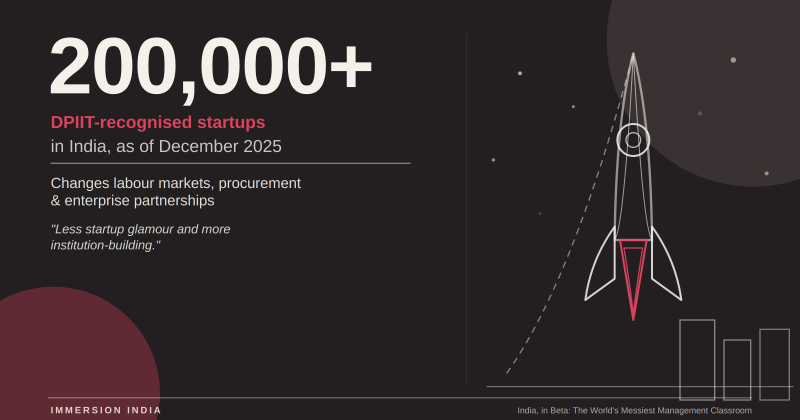
Startups: India crossed 200,000 DPIIT-recognised startups (as of Dec 2025), a scale that changes the labour market, procurement behaviour, and enterprise partnerships. (Press Information Bureau) This is less “startup glamour” and more “institution-building”: governance, compliance, and repeatable go-to-market in chaotic environments.
Retail and consumer: Quick commerce is a living case study in real-time operations—demand forecasting, inventory, dark-store productivity, and customer expectations compressed into minutes. Reuters cites a Bain/Flipkart report estimating $6–7bn in quick-commerce market share in 2024, growing rapidly. (Reuters)
A senior cohort does not need to “cover” these sectors. It needs to interrogate the management mechanics underneath them.
Finally, a market tour collects souvenirs. A lab collects data and stories that explain the data.
Picture a Monday morning in Bengaluru: a product head runs a stand-up while stuck in traffic, toggling between a warehouse dashboard, a customer-escalation thread, and a compliance note. Ten minutes later, in a Tier-2 city, a small distributor settles invoices by scanning a QR code and moves on because cash handling is slower than a phone tap now. (UPI’s scale makes that scene ordinary.) (Entrackr)
Or take a different setting: a plant manager explaining why defect rates fell—not because of a grand “quality programme”, but because a supplier ecosystem got standardised around a few non-negotiable metrics, and incentives stopped rewarding volume at the expense of reliability. That is how operational discipline actually travels: through procurement clauses, training rhythms, and “what gets escalated” rules, not motivational posters.
These are not “India stories”. They are leadership stories, amplified by India’s scale and speed.
What an India lab should produce in ExecEd terms
If you design the experience like a laboratory, the outcomes become sharper and more transferable:
- Systems thinking under load: map how identity, payments, data-sharing and governance interact (India’s digital public infrastructure is an unusually clear arena for this). (NeGD)
- Stakeholder choreography: regulators, platforms, incumbents, informal networks, and global supply chains in one operating theatre.
- Experiment design: rapid pilots with guardrails as metrics, controls, and kill criteria.
- Cohort learning: mixed teams (industry, function, geography) because India’s problems do not respect org charts.
The future: from “visiting India” to “learning the India method”
Over the next decade, the winners, inside and outside India, will borrow an approach that India has been forced to perfect: build for variability; ship in increments; design trust into systems; and assume customers will adopt what is simple, not what is sophisticated.
India is not a case study to be consumed. It is a living management practicum. The right executive programme does not return with photos. It returns with new reflexes and a stronger tolerance for reality.


