
India’s Operating System in the Field DPI and the new physics of frictionless scale
The first time you see it, it feels almost too small to be strategic.
A tea stall on a busy street. A queue that moves with the efficiency of mild impatience. A kettle whistling, paper cups stacked, and a laminated QR code taped to the counter like a devotional image. No card terminal. No cash drawer theatre. Just a scan, a soft ping, and the transaction vanishes into the air.
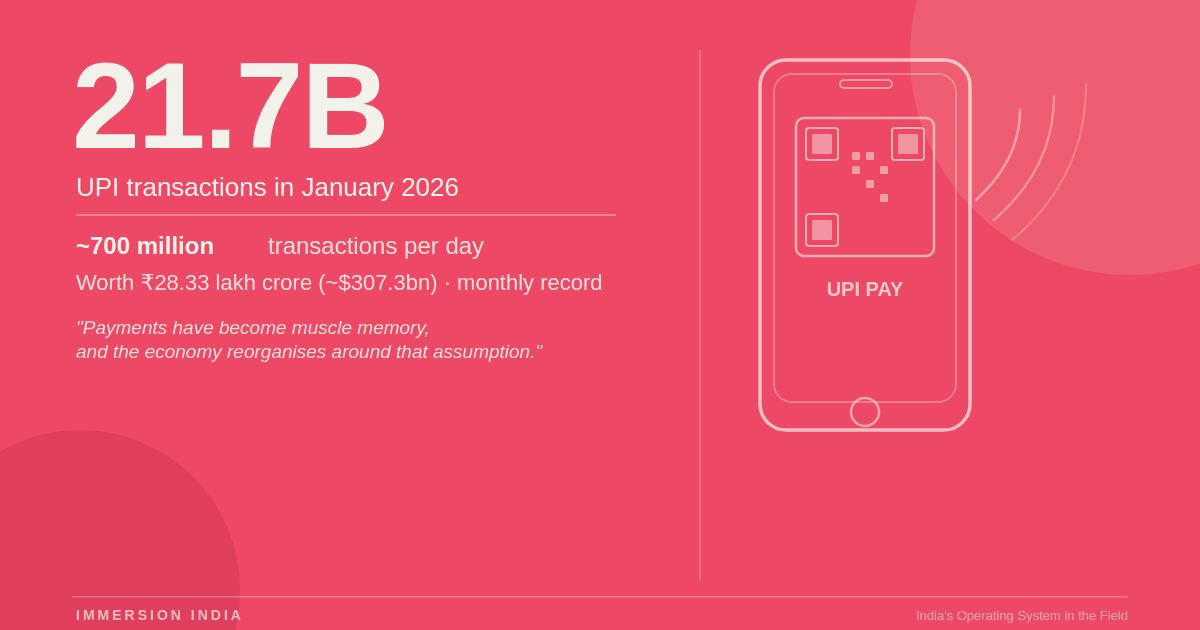
That little “ping” is India’s Digital Public Infrastructure (DPI) in its natural habitat: ordinary commerce executed at extraordinary scale, with friction engineered out of the most common actions. The point is not that tea is paid for digitally. The point is that payments have become muscle memory, and the economy reorganises itself around that assumption.
In January 2026, UPI processed roughly 21.7 billion transactions worth $307.3b or ₹28.33 lakh crore, a monthly value record, reported widely off NPCI data. (Business Standard) That is not a fintech statistic. It is a new baseline for how fast trust can travel.
When the rails work, competition moves upstairs
Most countries digitise by adding apps to old processes. India has been building rails namely identity, payments, documents, and consented data-sharing that behave like utilities. The result is a kind of national operating system: not a single platform, but interoperable primitives that firms can assemble into products, workflows, and markets.
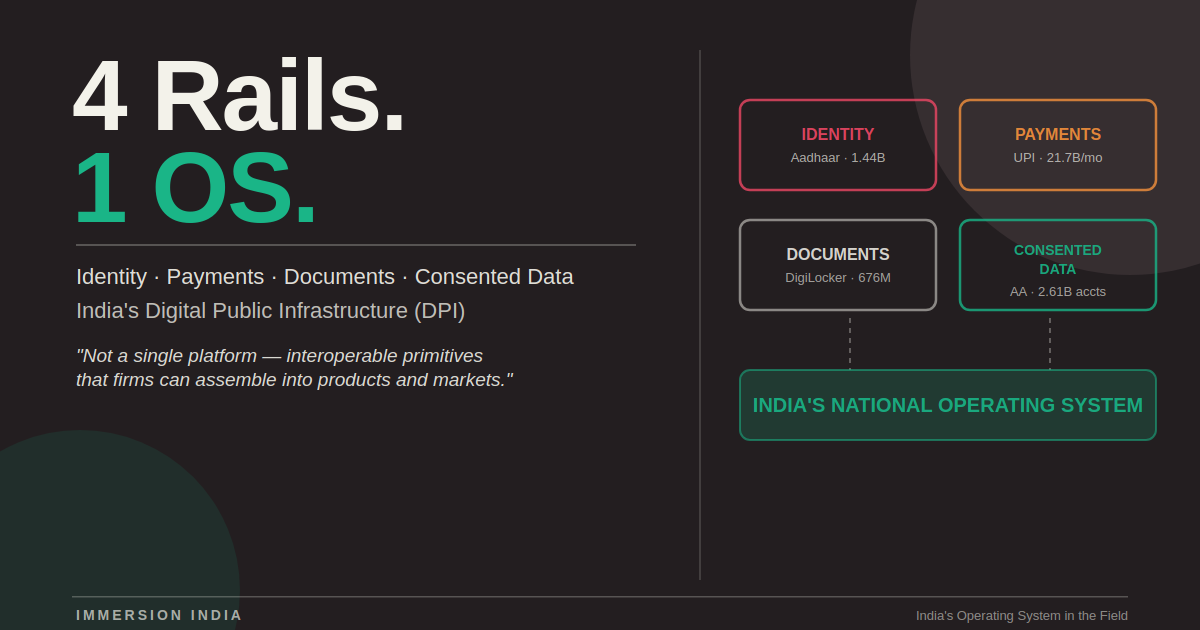
For visiting executives, this is where “India exposure” becomes genuinely educative. You’re not touring a market. You’re studying how execution changes when the underlying frictions are cheaper.
If the rails make onboarding fast and transactions effortless, advantage shifts away from mere access, that is, who has the biggest distribution muscle, and towards what you do with access: how you design workflows, handle exceptions, manage risk, and keep trust intact when something breaks.
And in India, something always breaks. That’s part of the lesson.
Identity: onboarding becomes a product decision
Start with the least glamorous and most consequential primitive: identity and authentication.
Aadhaar’s public dashboard lists ~1.44 billion enrolments, ~166 billion authentications, and ~22.33 billion eKYC transactions.
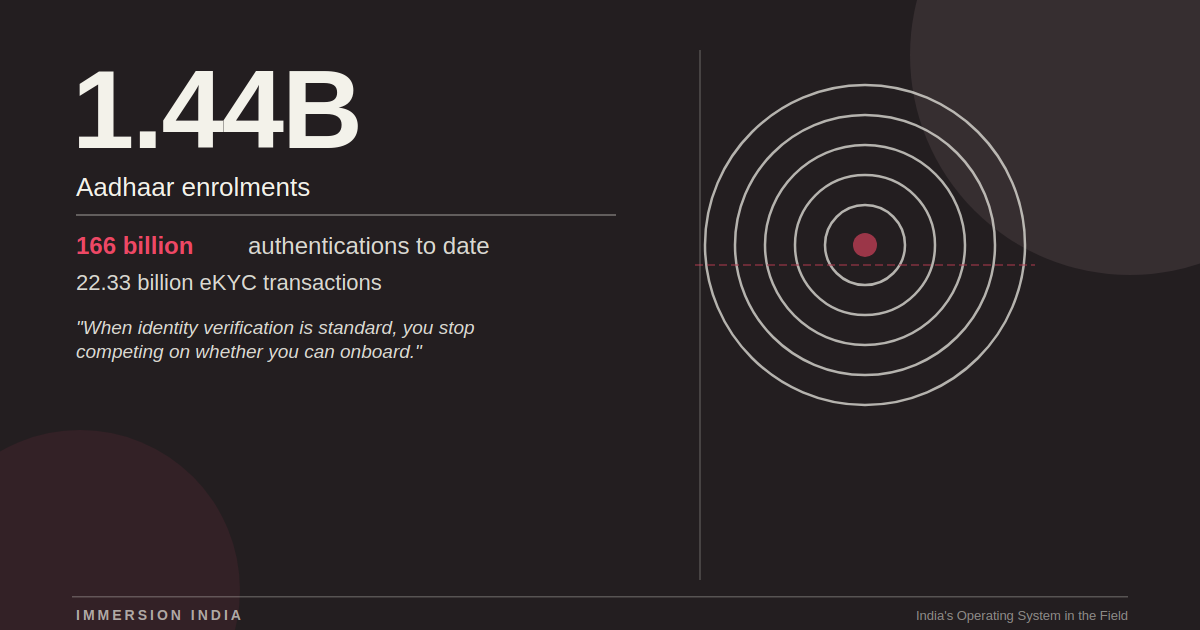
(uidai.gov.in) These numbers matter because they industrialise a once-bespoke activity: “proving who you are.”
In many markets, onboarding still feels like paperwork wearing a digital costume, form fields instead of forms. In India, onboarding increasingly behaves like a conversion funnel: you can time it, measure drop-offs, redesign it, and squeeze minutes into seconds.
The managerial implication is subtle: when identity verification is standard, you stop competing on whether you can onboard and start competing on how elegantly you do it, and how safely.
The bottleneck moves from compliance to design: error handling, language, edge cases, accessibility, and the “what happens next” choreography between customer, bank, agent, and platform.
Payments: the tea stall is the strategy slide
Return to the tea stall. It works because the rails are not merely present; they are pervasive.
UPI’s January 2026 monthly record is widely reported, alongside a daily run-rate of roughly 700 million transactions a day. (Business Standard) In an economy where payments are this ubiquitous, product design starts to assume instant settlement, real-time confirmation, and near-universal addressability. The payment step fades into the background; the workflow becomes the product.
That is why “DPI changes competition” is not an abstract claim. When everyone can accept money, advantage shifts to what follows the “ping”: refunds, disputes, fraud controls, reconciliations, customer support, and reliability under load. Trust stops being a marketing word and becomes an engineering discipline.
You see this in small scenes. A shopkeeper who once checked notes against the light now checks a phone screen. A delivery rider who once carried change now carries certainty. A customer who once waited for a card machine to connect now expects the payment to be faster than the conversation.
In India, customer patience is not a renewable resource.
Documents: when paperwork moves at digital speed, slow processes look absurd
Payments are visible. Documents are quietly revolutionary.
A government release notes that as of 5 March 2026, DigiLocker had 676.3 million users, and by March 2026 9,500+ million documents had been issued through the platform. (Press Information Bureau)
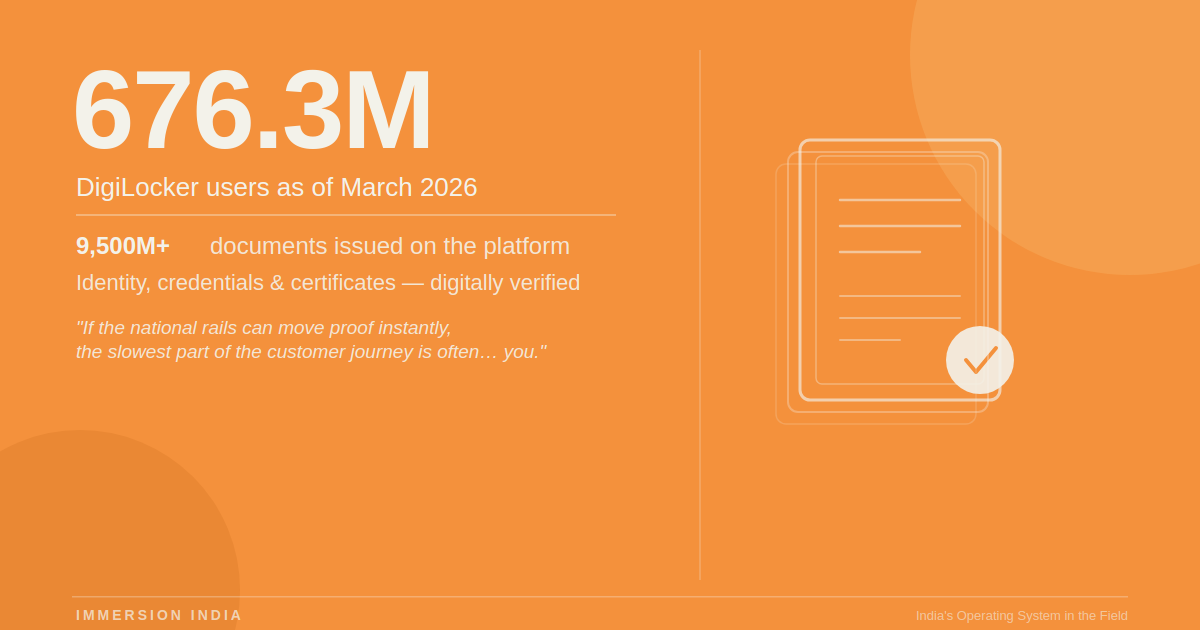
This is where visiting executives get an uncomfortable mirror. In many large organisations, the “digital transformation” story dies in the back office such as verifications, approvals, renewals, compliance checks, document custody. In India, document availability is increasingly treated as a system property. When verified credentials can be retrieved and shared digitally, entire workflows, for instance, hiring, onboarding, admissions, renewals, can be redesigned end-to-end.
Here, the competitive lesson is ruthless: if the national rails can move proof instantly, then the slowest part of the customer journey is often… you.
Consented data: speed with governance, or speed with regret
The next rail is less visible but strategically potent: consent-based data exchange through the Account Aggregator (AA) framework.
A Ministry of Finance release in September 2025 stated that over 2.2 billion financial accounts were enabled for secure, consent-based sharing and that 112.34 million users had linked accounts. (Press Information Bureau) And by January 2026, the Department of Financial Services’ AA page cites more than 2.61 billion accounts enabled and 252.9 million users linked. (financialservices.gov.in)
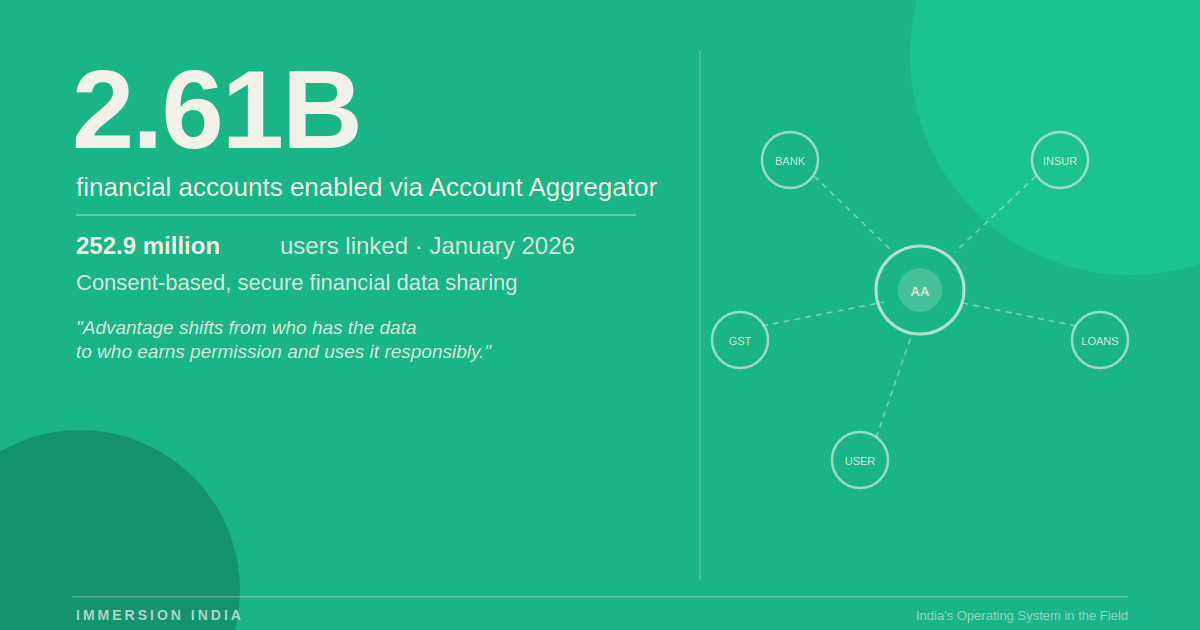
For firms, the promise is faster decisions, particularly for lending and underwriting, because data can move with permission and structure. The deeper managerial point is governance. DPI does not eliminate risk; it accelerates outcomes. When data moves faster, the cost of mishandling it rises. Firms must make consent legible, permissions auditable, and accountability explicit. In other words: the real competitive advantage shifts from “who has the data” to “who earns permission and uses it responsibly.”
This is the part most visiting cohorts underestimate because it’s not cinematic. But it is where durable advantage gets built.
The new physics: from distribution power to workflow power
Put these rails together and you get a different competitive landscape.
In the old model, incumbents won because distribution was expensive: branches, agents, marketing budgets, or monopolised interfaces. In a DPI-rich environment, distribution becomes cheaper and more contested. When onboarding, payments, and verification are standardised, the old moats shrink.
So where does advantage migrate?
It migrates to orchestration: how well you coordinate partners, manage exceptions, and deliver a coherent experience across multiple entities that don’t report to you.
It migrates to workflow ownership: not being the destination app, but being the system that solves the customer’s job-to-be-done end-to-end, reliably, repeatedly, and with fewer breakpoints.
And it migrates to trust engineering: designing systems that remain credible when failures occur. In a frictionless world, failure is not tolerated; it is remembered, screenshot, forwarded, and weaponised.
India teaches this lesson in public.
Why a cohort visit should feel like a lab practical
A market tour produces anecdotes. A lab visit produces hypotheses, tests, and transfer plans.
Executives who are coming to “see DPI,” should be put in places where the rails are used under pressure: a street merchant, a logistics hub, a customer support floor, a fintech risk team, a bank onboarding unit, a document verification workflow.
Then ask analyze:
What are the failure modes? Where does friction reappear, fraud, disputes, onboarding exceptions, support delays? What governance is baked into the rails, and what governance must the firm add? Which parts of the journey are now commodities, and which parts still differentiate?
India’s operating system is not a brochure. It is a live environment. It is noisy, imperfect, and deeply instructive.
And it starts, more often than not, with a cup of tea and a QR code.


